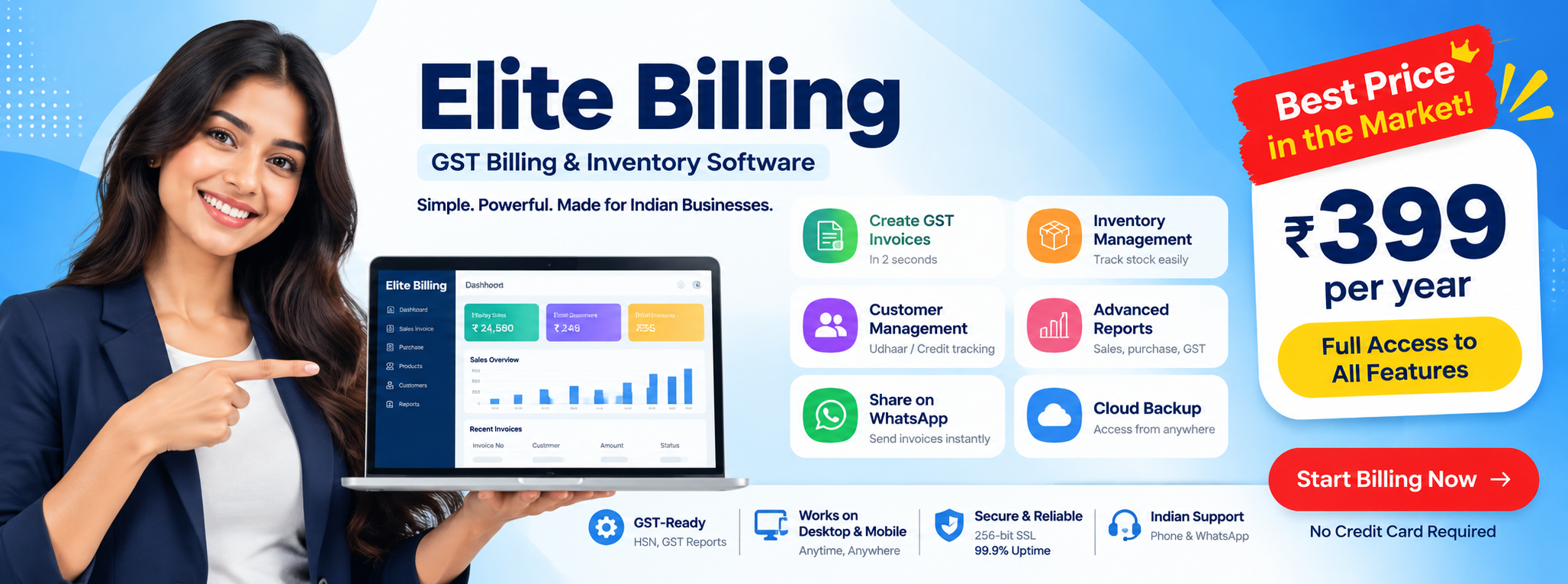
GST Compliance Software for Indian Businesses
If you are evaluating GST compliance software, the real question is not whether the software can print invoices. The real question is whether it helps your business stay aligned with GST workflows such as tax calculation, GST invoice structure, HSN and SAC handling, purchase records, GSTR reports, and Input Tax Credit tracking.
Many businesses still depend on spreadsheets, manual invoice templates, or old desktop tools. That creates avoidable risk in tax calculations, invoice data, return preparation, and reconciliation. A more reliable approach is to use GST-compliant billing software that keeps billing and compliance workflows connected.
Try Elite Billing — Just ₹399 Per Year
Affordable billing software for growing businesses.
This page is optimized for users searching for GST compliance software, GST billing software with compliance features, and GST-compliant billing software.
What GST compliance software should handle
- Automatic CGST, SGST, and IGST calculation
- HSN and SAC code support
- GST-compliant invoice fields and format
- GSTR-1 and GSTR-3B ready reporting workflows
- Purchase entry and ITC-aware record keeping
- Cloud access and cleaner updates than manual systems
Why GST compliance matters in billing software
GST compliance is not a separate task from billing. It starts at the transaction level. If invoice data, tax breakup, customer details, HSN or SAC values, and purchase records are incomplete or inconsistent, the compliance problem begins before return filing.
- Mistakes in tax splitting create filing issues later
- Weak purchase records affect ITC visibility
- Incomplete invoice fields increase audit and reconciliation risk
- Disconnected stock and billing workflows can distort tax-related reporting
That is why businesses often search for GST compliance software instead of only searching for generic billing tools.
Core GST compliance features billing software should include
1. Automatic tax splitting
The software should correctly apply CGST and SGST for intra-state transactions and IGST for inter-state transactions. Manual tax handling is one of the most common sources of errors.
2. HSN and SAC code management
Products and services should carry proper HSN or SAC codes in the workflow. Good billing software stores these at the item level so invoice compliance is more consistent.
3. GST-compliant invoice structure
Invoices should contain the required business and tax fields such as GSTIN, invoice number, place of supply, tax breakup, and item-level details where relevant.
4. GSTR-1 and GSTR-3B oriented reporting
Good GST compliance software should help businesses organize data for return preparation rather than forcing teams to rebuild reports manually each month.
5. Purchase records and ITC-aware workflows
Input Tax Credit depends on purchase-side discipline. Billing software should support purchase entries and related record keeping so businesses have cleaner data for tax review and reconciliation.
6. Inventory and billing connection
If the software also handles stock, billing and inventory should stay connected. This helps maintain cleaner operational records and reduces mismatch between sales, purchases, and reporting.
What happens without proper GST compliance software
Businesses relying on Excel or old offline tools often face the same recurring problems:
- Incorrect tax slabs on invoices
- Mismatched invoice data
- Weak HSN or SAC discipline
- Missing purchase entries that affect ITC review
- Stress around GSTR preparation and reconciliation
A stronger billing system reduces these issues by keeping tax-related workflows inside the day-to-day operating process. Businesses still using notebooks, Excel, or fragmented software can prepare better with this manual invoicing to automated billing migration guide.
Who should use GST compliance software
- Retailers
- Wholesalers
- Distributors
- Manufacturers
- Service businesses
- Multi-branch businesses
- GST-registered small businesses
- Businesses moving away from manual billing
Cloud GST compliance software vs offline workflows
| Area | Cloud Billing Workflow | Older Offline Workflow |
|---|---|---|
| Tax updates | Easier centralized updates | Often manual and slower |
| Access | Browser-based and flexible | Usually device dependent |
| Backup | Cleaner backup processes | Higher local dependency |
| Compliance workflow | More connected to billing data | Often fragmented |
Monthly GST checklist for businesses
- Verify invoice data and customer tax details
- Record all purchase invoices cleanly
- Review HSN and SAC consistency
- Check tax summaries before filing preparation
- Review sales, purchase, and stock alignment where relevant
If you are comparing software more broadly and not only from a GST lens, use how to choose billing software in India to weigh compliance together with pricing, migration, and operational fit.
How Elite Billing supports GST compliance workflows
Elite Billing is designed for Indian businesses that need a practical billing workflow with GST-oriented features. It helps connect invoice generation, tax calculation, stock-aware billing, and reporting in one operational system.
- Automatic GST calculation support
- Tax-ready billing workflows
- Cloud accessibility
- Cleaner record keeping for reporting and review
- Support for billing plus stock management where needed
Businesses comparing billing software with stock management, billing software in Tamil Nadu, or affordable billing software in India may use this page to evaluate the GST-specific side of the workflow.
FAQ
Can I use GST compliance software if my business is not GST registered?
Yes. Businesses can generate regular invoices or Bill of Supply and switch to GST-ready workflows when registration is available.
Does cloud billing software update automatically when GST rules change?
Cloud-based billing software can apply tax engine and workflow updates more easily than manual offline systems.
Can GST compliance software support multiple GST numbers?
Yes. Many cloud billing systems support multiple branches or GST registrations depending on the business setup.
What GST features should billing software include?
Good GST compliance software should support GST invoices, tax splitting, HSN and SAC codes, GSTR reports, purchase records, and ITC-aware workflows.
Conclusion: choose billing software that supports real GST compliance
If you are searching for GST compliance software, focus on whether the product supports real day-to-day compliance workflows: tax calculation, invoice structure, HSN and SAC discipline, purchase records, GSTR-oriented reporting, and ITC-aware record keeping.
Elite Billing gives Indian businesses a practical path to handle GST-oriented billing more cleanly inside a connected cloud workflow.
Simplify GST Compliance
Explore cloud billing software built for Indian business workflows.
Book a Free Demo